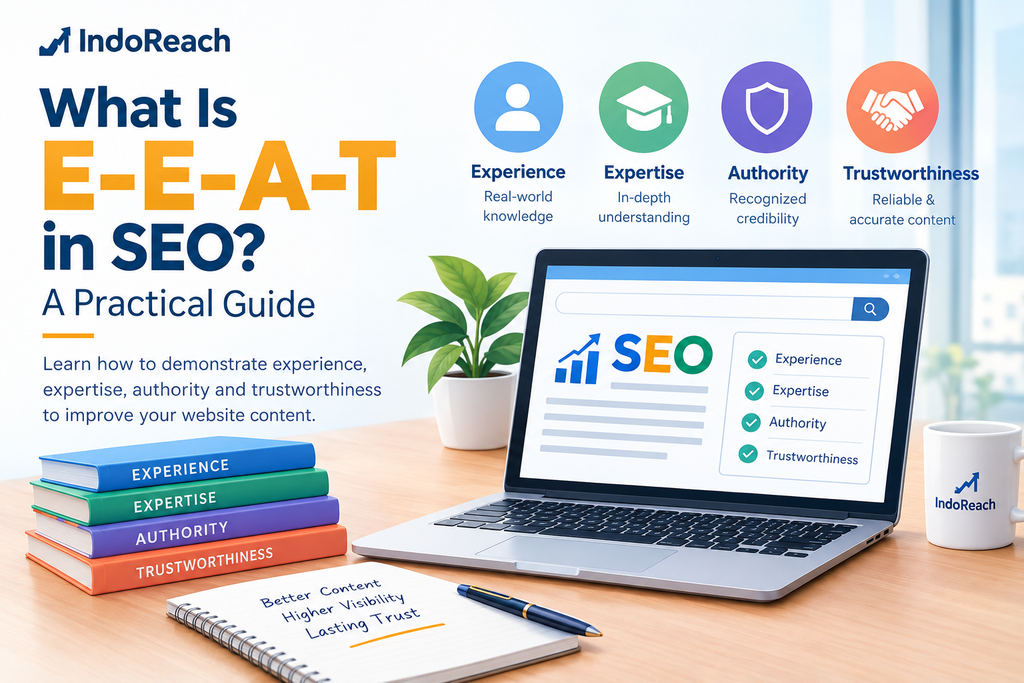
What Is E-E-A-T in SEO? A Practical Guide
Learn how experience, expertise, authoritativeness and trustworthiness can help you create more useful, credible website content.
Search engines help people discover your website, but useful content must do more than repeat keywords. Visitors want reliable answers, real-world insights and reasons to trust the business providing them.
This is where E-E-A-T in SEO becomes important. Google uses the concepts of experience, expertise, authoritativeness and trustworthiness to describe qualities associated with helpful, reliable content.
In this guide, you will learn what E-E-A-T means, how to apply it to your website, and how WordPress Gutenberg and Yoast SEO can support your optimization process.
What Is E-E-A-T in SEO?
E-E-A-T stands for Experience, Expertise, Authoritativeness and Trustworthiness. Google discusses these concepts in its Search Quality Rater Guidelines and guidance for creating helpful, reliable, people-first content.
Experience
Does the content demonstrate relevant first-hand experience?
Expertise
Does the creator demonstrate appropriate knowledge or skills?
Authoritativeness
Is the creator or website recognized as a reliable source?
Trustworthiness
Is the information accurate, transparent and dependable?
Is E-E-A-T a direct Google ranking factor?
E-E-A-T is not a single, standalone ranking factor or a score that website owners can directly increase. Google’s systems use multiple signals to identify helpful and reliable content.
The practical lesson is to publish content that genuinely helps people and makes its credibility easy to assess.
The Four Pillars of E-E-A-T
1. Experience: Demonstrate What You Have Done
Experience means showing relevant first-hand knowledge rather than simply repeating general information.
For example, a digital marketing agency could publish a case study explaining a client’s challenge, the strategy implemented, the work completed and the results measured.
- Describe the original business problem.
- Explain the actions and strategy used.
- Include the timeframe and relevant circumstances.
- Share results supported by real data.
- Explain the lessons other businesses can learn.
Obtain permission before publishing confidential client information. Never invent results, testimonials or project experience.
2. Expertise: Explain What You Know
Expertise involves demonstrating appropriate knowledge about the subject. Businesses can do this through accurate explanations, original analysis, detailed guides and useful answers to customer questions.
Instead of simply saying that SEO improves visibility, explain how search intent, keyword research, page structure, internal linking and content quality work together.
Where appropriate, include an accurate author biography describing relevant qualifications, professional experience or subject knowledge. Specialist and sensitive topics may require qualified expert review.
3. Authoritativeness: Earn Recognition
Authoritativeness concerns the recognition a person, organization or website earns in a relevant subject area.
- Publish original research and useful industry resources.
- Support important claims with credible references.
- Earn legitimate mentions from relevant websites.
- Demonstrate a consistent record of useful work.
- Maintain accurate and consistent business information.
Authority should be earned through genuine value. Manipulative link schemes and fabricated credentials can undermine credibility.
4. Trustworthiness: Make Credibility Verifiable
Trustworthiness is central to E-E-A-T. Visitors should understand who operates your business, what your services include and how to contact you.
- Provide accurate contact details and business information.
- Explain services clearly and honestly.
- Make relevant privacy policies and terms accessible.
- Check website security and ensure forms work correctly.
- Support claims with evidence and accurate references.
- Use genuine author information and testimonials.
A professional design can improve presentation, but appearance alone does not establish trust. Your information and business practices must support the impression your website creates.
How to Improve E-E-A-T on a Business Website
Use this practical process to review an existing blog post or service page.
Step 1: Identify the Reader’s Actual Question
Determine what the reader wants to understand or accomplish. Someone searching for E-E-A-T may want a definition, practical optimization advice or help improving website credibility. Answer the main question early, then provide enough detail to help readers take the next step.
Step 2: Add Original Value
Review competing articles and identify what your page can contribute beyond a basic definition. Consider adding a genuine project example, an original checklist, an expert explanation or a useful workflow. Original value does not require a large research budget; it requires relevant insight that is accurate and clearly explained.
Step 3: Review Author and Business Information
Make it easy for readers to identify the person or organization responsible for the content. Use accurate author profiles, relevant professional experience and transparent business details. Identify reviewers only when they have genuinely reviewed the work.
Step 4: Support Important Claims
Link factual claims to credible sources. For SEO guidance, Google’s official documentation is a strong starting point. For technical or specialist claims, consult relevant authoritative documentation or qualified experts. Check that each reference actually supports the statement.
Step 5: Keep Content Accurate and Useful
Review older articles when information changes or new evidence becomes available. Update outdated examples, correct factual errors and remove unsupported claims. Change a published date only when it accurately reflects a meaningful update.
Step 6: Review the Entire Page
Check readability on mobile, working links, meaningful image alternative text, relevant internal links, page titles, meta descriptions and indexing settings. Content quality and technical usability should work together.
How Gutenberg and Yoast SEO Help
WordPress Gutenberg and Yoast SEO support different parts of the publishing process. Neither tool can replace useful content or genuine evidence of credibility.
Using Gutenberg for Content Quality
Structure the article with one clear H1 title, H2 headings for major sections and H3 headings for relevant subsections. Break long paragraphs into manageable sections and use lists when they make information easier to scan.
Add images when they explain a concept or provide useful evidence. Write alternative text that accurately describes meaningful images rather than inserting keywords into every image description.
Using Yoast SEO for On-Page Optimization
Yoast SEO can help you review:
- Focus keyphrase placement and usage.
- SEO title and meta description.
- Readability feedback.
- Internal and external links.
- Relevant technical SEO settings.
A green indicator is a useful checklist signal, not a guarantee of rankings. Yoast cannot verify whether your experience is genuine, every claim is accurate or readers will find the article valuable.
Should You Aim for 2% Keyword Density?
No fixed keyword-density percentage is required by Google. For this article, use E-E-A-T in SEO naturally in the introduction, a relevant heading and appropriate parts of the body. Include related terms when they improve clarity.
Forcing a keyphrase into every section can make writing repetitive. Review Yoast’s feedback, but prioritize natural language, search intent and reader usefulness over a numerical target.
Focus on answering the searcher’s question completely. Use related concepts such as content quality, helpful content, website credibility and author expertise where they genuinely fit.
E-E-A-T, AI Search and Answer Engines
Useful, credible content is also easier for people and automated systems to interpret. Whether a reader discovers your page through traditional search, an answer engine or a generative AI experience, clear explanations and credible evidence are valuable.
- Answer the main question directly.
- Use descriptive headings that match the content below them.
- Explain specialist terms when they first appear.
- Provide evidence for important claims.
- Include original examples and useful details.
- Keep important information available as crawlable page text.
- Maintain accurate author and business information.
These practices can improve clarity and usefulness, but they do not guarantee that an AI system will cite, recommend or display your website.
E-E-A-T Website Audit Checklist
Use this interactive checklist to review a blog post or service page. Tick each item as you verify it.
This checklist is a practical review aid, not a Google ranking score.
Common E-E-A-T Mistakes to Avoid
Keyword Stuffing
Repeating phrases unnaturally does not make an article more helpful. Write for people and use relevant terminology naturally.
Fake Experience
Invented case studies, testimonials or credentials undermine trust. Publish only claims you can substantiate.
Unsupported Promises
Avoid guaranteeing search rankings, traffic or sales without a defensible basis. Explain your services and limitations honestly.
Generic Content
Repeating common definitions without adding useful insight limits an article’s value. Include relevant examples, clear explanations or an actionable process.
Ignoring the Author
Readers should be able to understand who created the content and why the information is credible.
Focusing Only on Plugin Scores
SEO tools can help identify issues, but a perfect plugin score does not guarantee good content or search performance.
Frequently Asked Questions
Is E-E-A-T a direct Google ranking factor?
E-E-A-T itself is not a single direct ranking factor. Google uses multiple systems and signals to identify helpful, reliable content. E-E-A-T provides a framework for assessing content quality and credibility.
Can Yoast SEO automatically improve E-E-A-T?
No. Yoast SEO supports on-page optimization and readability checks. Genuine experience, expertise, authority and trust must be demonstrated through your content and business practices.
Should every article have 2% keyword density?
No. Two percent is not a Google requirement. Use your focus keyphrase naturally and follow SEO tool feedback without sacrificing clarity or usefulness.
Does Gutenberg improve Google rankings?
Gutenberg helps you create structured content, but the editor itself does not guarantee better rankings. The quality, relevance, accessibility and usefulness of the published page matter.
How can a small business build online trust?
Provide accurate service information, transparent business details, genuine customer feedback, relevant examples, accessible policies and useful answers to customer questions.
Does E-E-A-T matter for AI search?
Credible, well-structured and useful content is a sensible foundation for traditional search and AI-assisted discovery. No particular E-E-A-T technique guarantees inclusion in AI-generated answers.
Trusted Resources
Consult official guidance when reviewing your SEO strategy:
Build Better Content with IndoReach
Improving your website requires more than adding keywords or installing an SEO plugin. It involves understanding your audience, publishing useful content, strengthening credibility and making it easier for potential customers to take action.
IndoReach helps businesses approach digital marketing with a focus on relevant content, website optimization and business growth.
Discuss Your Website